Medicaid coverage for ABA therapy in Illinoishas changed in recent years, and keeping up with regulations and eligibility can be challenging. At Stride Autism Centers®, our mission is to help young children with autism build meaningful skills and prepare for kindergarten and beyond. We know that families often have questions about how to pay for care and one of the most common is whether Medicaid covers ABA therapy in Illinois. The short answer is yes, but it’s complicated.
Medicaid Coverage for ABA Therapy in Illinois
Since October 2020, the state of Illinois has recognized ABA therapy as a medically necessary treatment for children and young adults under 21 with autism. That means ABA can be covered under the Medicaid program through the Early and Periodic Screening, Diagnostic, and Treatment (EPSDT) benefit.
However, ABA Therapy Medicaid Access in Illinois is still very limited. The state’s reimbursement rates for providers remain low, which makes it financially challenging for many ABA organizations, including Stride, to participate in the program. As a result, families often face long waitlists or difficulty finding local providers who accept Medicaid.
How Families Can Access ABA Therapy Through Medicaid
Even with these challenges, there are steps families can take:
Developmental screening: Ask your pediatrician for an early autism screening or connect with your local Child and Family Connections office to start the Early Intervention process.
Obtain a formal diagnosis: A developmental pediatrician, licensed child psychologist, or neurologist can provide the evaluation needed for ABA coverage.
Work with your Medicaid Managed Care Organization (MCO): Each MCO maintains a list of approved ABA providers. Your pediatrician or an LCSW can help you navigate this process.
Request an ABA assessment: If approved, your child will complete an initial ABA assessment to set goals and recommended therapy hours.
Commercial insurance: During your employer’s open enrollment, you may be able to add coverage that includes ABA therapy. We partner with an experienced insurance broker who can help you evaluate affordable plans.
Government programs: The Illinois Health Insurance Premium Payment (HIPP) Program may help cover the cost of private insurance if you already qualify for Medicaid.
Local resources: Organizations such as the Chicago Autism Network offer Therapy Assistance Grants that can offset ABA expenses.
How Families Can Drive Change
Medicaid coverage for ABA therapy in Illinois has improved thanks to parent and advocate leadership. Until 2023, the state required every hour of ABA therapy for children on Medicaid to be directly supervised by a licensed clinical psychologist or psychiatrist. While intended to ensure quality, this rule created the opposite effect, there weren’t enough licensed professionals available, which left many families facing long waitlists and struggling to access care. Families and advocacy groups, including the Illinois Autism Insurance Coalition, came together to share their stories and push for change, ultimately helping remove this supervision requirement for Board Certified Behavior Analysts (BCBAs).
This update may sound like a small technical detail, but it has had a significant impact on ABA Therapy Medicaid Access in Illinois. By aligning regulations with how ABA is safely and effectively delivered, more providers can now participate and more children with autism can receive therapy through Medicaid. There’s still more work ahead, but this progress shows the power of families speaking up and reminds us that advocacy can directly expand access to the care children and families need.
By continuing to share your stories with local representatives and supporting advocacy groups, you can help expand access to ABA Therapy for more children and families.
At Stride Autism Centers®, we’re committed to supporting families every step of the way, from providing resources while you wait for services to advocating for greater access to care across Illinois and the Midwest.
If you have any questions or would like more information, Stride Autism Centers® is here to help. Get started today.
New foods can feel big for children with autism — and for parents and caregivers like you. If your kiddo isn’t ready to try new foods yet, that’s okay! A few ways to explore new foods with your child include playful activities that build comfort with new tastes, colors, smells, and textures in tiny, predictable steps. Let’s explore the connection between food, play, and Applied Behavior Analysis (ABA) and some quick, no-pressure food exploration tips you can try at home.
The Connection Between Food Play for Children With Autism and ABA Therapy Goals
Many autistic kiddos find new foods challenging at first. Play turns those moments into safe, fun practice. When you use play, structure, and positive reinforcement — the core of ABA therapy — you give your child real choices and fun reasons to engage. It’s all about participation since tasting stays optional.
Playful food activities also help support ABA therapy goals like:
Increasing food acceptance in children: Play breaks up big steps into smaller ones. Looking, smelling, and touching at your child’s own comfort level builds familiarity with new foods.
Reducing food-related resistance: Predictable routines, clear choices, and the ability to opt out reduce stress and keep participation positive.
Improving tactile tolerance: Graded sensory input, such as starting with tools or gloves first, lets your child explore textures and take the next step at their own pace.
Enhancing communication around food: Simple language and visual supports help your child request, comment on, or politely decline new foods.
Pairing food with community to enrich social skills: Playing food-related games with family members and peers introduces important social concepts like taking turns, waiting, and cheering for others. The shared play makes new food experiences feel safer and more fun.
Set Up Sensory Exploration Stations to Experience New Foods
Sensory exploration stations are a great way to start transforming mealtimes. These stations are quick and easy to set up, and they let your child experience new foods through looking, touching, and smelling without the pressure to taste.
Mystery Boxes and Bags
Mystery boxes and bags are the perfect starting point since they allow your child to feel foods without seeing them first. This can help make touching new textures feel less scary or overwhelming. Try out these ideas:
Small cardboard boxes with a hole for little hands
Cloth bags and drawstrings
Shoeboxes with a sleeve
It’s best to start with familiar foods that your child already accepts. Choose whole, sturdy foods like apples and oranges or an unpeeled banana. Dry pasta shapes, lemons, and potatoes are also great choices. Ask questions about what your child feels, such as whether it’s smooth or bumpy, and celebrate any descriptions they offer. You can also increase the playfulness by allowing your child to put items in the box for you to guess.
Smell Tests
Smell tests offer a gentle way to explore new foods since almost 80% of taste comes from our sense of smell. These tests are simple to create with everyday items, like clean spice jars, empty salt shakers, or small containers with holes in the lid.
Start with familiar, pleasant scents your kiddo may enjoy, such as:
Fruit pieces or peels
A cinnamon stick
Fresh herbs, such as peppermint or basil
Peanut butter
Amp up the playfulness by asking simple questions like whether it smells sweet or nutty. You can also turn this activity into more of a game and take turns with your child. For example, use two jars and have your child identify the one with a specific scent, or let your child make a smell mystery for you.
If your child is more sensory-sensitive, start with milder scents and keep containers further away. Consider offering a paper fan, and always let your kiddo control how close they get to the smell.
Texture Trays and Sensory Bins
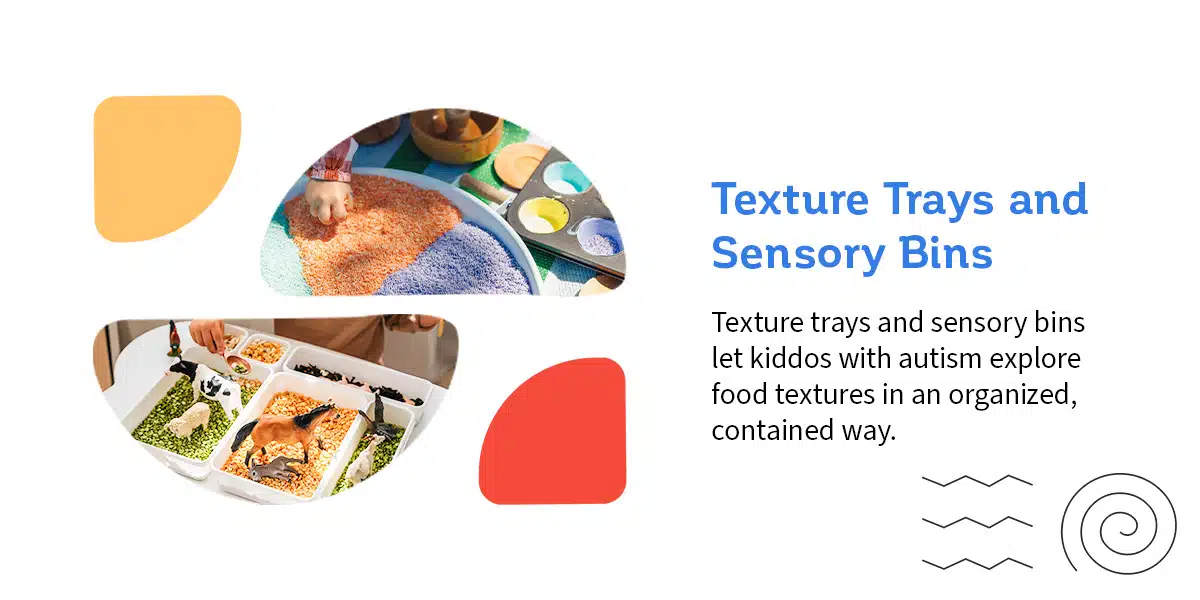
Texture trays and sensory bins let kiddos with autism explore food textures in an organized, contained way. They’re easy to create with everyday items like:
Divided plates
Muffin tins
Small plastic bins and bags
Fill each section or container with foods that offer different textural experiences. Some great choices include:
Dry pasta, beans, or rice for scooping and dumping
Smooth yogurt in a zip-close bag for squishing
Crackers for breaking or crumbling
Cool, cooked noodles for stretching
Include familiar foods your kiddo already accepts alongside new ones to help build comfort. Exploration is often easier and more fun with tools like spoons, scoops, or brushes.
Smaller portions can help keep kiddos from getting overwhelmed, and you can vary the activity based on your child’s personal sensory tolerances. Sensory seekers may appreciate differences, such as the crunchiness of dry cereal or the temperature of cold grapes in a zip-close bag. For kiddos who are sensitive to sensory experiences, offer utensils or gloves they can use to explore instead.
Tips for Success With Sensory Stations
Keep these ideas in mind to help make sensory exploration positive and pressure-free:
Try just one station type at a time, starting with what you feel will be most comfortable for your child.
Stay close by for supervision, support, and positive feedback.
Keep mystery box and texture tray sessions short since brief activities often feel more manageable.
Let your child know they can opt out, end, or take a break when they need to.
Always offer immediate praise or a small reward to celebrate every win like touching with tools or describing what they notice.
Transform Food Into Art
Creating art projects together is another fun way to explore new foods!
Consider painting with colorful purees, using a plate or parchment as a canvas. A few slices of fruit or vegetables can make great “stamps” for your budding young artist. Making silly faces and colorful rainbows with food is another activity that many autistic children enjoy. As your child works, narrate with simple sensory words and colors, such as asking if they’d like red or green next.
Try inviting tiny next steps, like touching or smelling the food. If direct touch is tough for your kiddo, offer tools or gloves. It’s okay to model the behavior yourself, too. Explain what you’re doing, or let them choose what’s next. Remember that watching, directing, and commenting are great ways to participate.
It’s best to keep the portions limited to help prevent overwhelm. Food art projects may take a bit longer, but you’ll still want to look for cues that your kiddo needs a break. As with any food-related play activity, constant supervision and celebrating every effort are a must.
Engage in Food-Themed Games
Food exploration for children with autism becomes even more engaging with these structured games.
Food Bingo
Food bingo starts with a picture-based card with a mix of familiar, accepted foods and new ones. Your child can mark squares by eating a food they’re comfortable with, while earning the square for new ones simply by touching, looking, or smelling. Having the whole family join in and using stickers to indicate progress makes it even more playful and reinforces budding social skills. You can try tying each “bingo” to a reward to keep everyone engaged and extend the game for as long as you like.
As with other games, include options for your kiddo to decline. Offer positive reinforcement like immediate praise every time your kiddo marks a new square to celebrate their efforts.
Two-Bite Taste Test
This simple game lets your child be in charge while keeping portions tiny and manageable. Offer two small bites of food, one familiar and one new, and have your kiddo choose which to try first. They may prefer the familiar one to start, and that’s okay — it can help them build their confidence.
Keep it playful by:
Using pea-sized bites.
Allowing a no-thank-you option.
Letting your child set the pace.
Modeling trying foods yourself first.
Making it social with siblings or family members.
Using a fun, three-two-one-touch countdown.
Varying the approach can make the activity more interesting and engaging. Consider doing it with siblings in the park as a picnic, or pretend you are chefs and use toy kitchen items to “prepare” the food.
Let’s Help Your Child Thrive Together
Stride Autism Centers® offers personalized, center-based ABA therapy for autistic kids ages 2 through 6 across the Midwest. We’re fully accredited by the Autism Commission on Quality (ACQ) in Illinois, Iowa, and Nebraska, and we use an evidence-based program to help your kiddo build essential skills through play, structure, and positive reinforcement. In our centers, your child learns and grows through naturalistic group activities and individualized one-on-one therapy in a supportive, sensory-friendly environment.
Call our caring, experienced team at 515-207-5251 or connect with us online to see how we can work together to help your child thrive.
At Stride Autism Centers®, therapy isn’t just effective, it’s joyful, playful, and deeply thoughtful. That spirit is on full display each summer at our Hickory Hills, Illinois clinic, where an imaginative and therapeutic tradition has taken flight (literally!) for three years running.Welcome aboard Stride Airlines, a flight simulation experience designed to help young children with autism feel more comfortable with the idea of flying. What began as a personalized intervention for one client has since blossomed into a beloved annual event, one that brings smiles, snacks, and some serious skill-building to our summer programming.
From One Client’s Needs to a Whole-Clinic Tradition
The tradition started when Emily Rodman, a Board Certified Behavior Analyst (BCBA) at Hickory Hills, was supporting a child who felt anxious about flying. With a summer vacation approaching, Emily worked closely with the family to prepare him for the experience.“We created custom social stories, connected the family with TSA Cares, and introduced role-playing to help him understand what to expect,” she explained. “To bring it to life, we set up a full simulation of a flight, from boarding to snack service.”The impact was so positive that the team decided to make it a yearly event for all Stride clients at Hickory Hills.
A Journey With Therapeutic Purpose
While the flight simulation is packed with fun, it’s rooted in meaningfultherapy goals. During the simulation, children practice:
Receptive language skills, like following directions (“Come here,” “Sit down”)
Group participation, such as sitting with peers and engaging in a shared activity
Waiting and transitioning, through lining up to “board” and remaining seated during the “flight”
Requesting and choice-making, like picking between snack options or asking for help
“The kids get to practice real-world behaviors in a setting where they feel safe and supported,” Emily shared. “This makes it easier to carry over those skills to actual experiences outside of Stride.”
Bringing the Magic of Flying to Life
Thanks to a little help from Emily’s fiancé, who works for a major airline, the experience feels extra real. He provides authentic first flight wings, activity books, and airline snacks that make the simulation feel just like the real thing.“We prepare boarding passes, simulate airport lines, and even announce the destination, this year, the kids flew to Hawaii!” said Emily. “They love choosing their snacks, flipping through their activity books, and earning their wings.”Children boarded a pretend aircraft, took their seats in rows, and listened carefully as staff made flight announcements. Some even peeked out imaginary windows as the “plane” took off.
Why It Matters
For many children with autism, new experiences, especially those that involve transitions, crowds, or unexpected sensory input, can feel overwhelming. That’s why Stride prioritizes real-world readiness in our programming.By embedding life-skill preparation into engaging and joyful experiences, our team helps children gain confidence, build tolerance for new environments, and learn how to navigate situations that they’ll likely encounter in their day-to-day lives.“Our approach at Stride is always guided by each child’s clinical goals, but we also know how important it is to make learning fun,” said Emily. “The flight simulation is a perfect example, it’s play-based, highly motivating, and full of learning opportunities.”
The Stride Difference
At Stride, we believe that therapy should feel meaningful and magical. Whether it’s simulating a flight, exploring a pretend grocery store, or participating in seasonal crafts and celebrations, our team is constantly designing activities that balance structure with joy.And while the kids may think they’re just having fun on their way to Hawaii, we know they’re also practicing skills that will serve them for a lifetime.We’re already counting down the days until Stride Airlines takes off again next summer, and we can’t wait to see where our clients venture to next.
At Stride Autism Centers®, we’ve always believed that quality isn’t a goal, it’s a responsibility. Today, I’m thrilled to share a major milestone that speaks to that belief. Stride is now fully accredited by the Autism Commission on Quality (ACQ) in Illinois, Iowa, and Nebraska. Even more exciting, we’re the first ABA provider in the state of Nebraska to earn this prestigious honor.
This accreditation is a big deal. The ACQ holds organizations to some of the highest standards in our field. To meet these standards, our team went through a long and detailed review of our clinical care, business practices, safety systems, and more. Every aspect of what we do was examined. The result? A perfect score. That’s right, Stride passed every single part of the ACQ’s rigorous evaluation.
Why did we do this? Because we want families and communities to know that they can trust us. We want them to feel confident that their children are receiving care that’s thoughtful, evidence-based, and driven by compassion. And we also want current and future team members to know that when you join Stride, you’re joining an organization that sets a high bar, and clears it.
Our journey to accreditation took time, energy, and unwavering dedication. I want to give a heartfelt thank you to everyone who helped make this happen, whether you were part of our clinical team, our central support team, or helping behind the scenes. You played an integral role.
This recognition isn’t just about meeting standards. It’s about exceeding them, for the families we serve, the children we support, and the communities we’re proud to be part of, especially in places where quality autism care hasn’t always been easy to find.
It’s also a moment to reflect on our culture. Stride has been named a Top Workplace for two years in a row, with special recognition for our Professional Development and Employee Wellbeing programs. That’s not a coincidence. High-quality care starts with a team that feels valued and empowered. We’re nothing without our team members.
This is a proud moment for all of us. We are honored to achieve this milestone and are committed to lead with excellence and purpose.
Kristy and Shelley Welcome You to Stride Autism Centers®, Cedar Rapids
We’re thrilled to announce the opening of our new clinic in Cedar Rapids on May 1st! At Stride, we believe every child deserves access to high-quality, compassionate ABA therapy—and we’re proud to expand that mission here. In the spirit of community and connection, Kristy Walker and Shelley Swan from our Cedar Rapids leadership team have written personal letters to introduce themselves and share their passion for supporting children with autism.
If you’re considering ABA therapy for your preschooler, we encourage you to read their stories, learn about their dedication, and reach out to us. We would love to welcome you to our Stride family. Call us at(515) 207-5251 or visit our Clinic page.
A Letter from Kristy Walker, Clinic Director
I grew up in Iowa, having moved to Cedar Rapids when I was 9. I stayed in Iowa City for college, then spent a short four-year stint in Illinois for grad school before returning to Cedar Rapids—because there’s just something special about this place. The people, the lifestyle, and the deep focus on family and community are what I love most about Iowa.
I’ve been working with kids ever since I was old enough to take a babysitting class and help out the neighbors. After returning from grad school, I knew I wanted a career that allowed me to support children and help them thrive. That’s when I stumbled upon an ABA clinic—the only one within more than 100 miles. Eleven years later, I earned my BCBA and stayed in the ABA field ever since.
While the number of ABA options has grown in the past decade, so has the need. Cedar Rapids is the second-largest city in Iowa and serves as a central hub for many surrounding rural communities that have historically been underserved. With a strong focus on growing families, the demand for early intervention ABA services here continues to rise.
That’s why I’m so excited about the opening of a Stride clinic in Cedar Rapids. It’s a much-needed resource for a growing population, and it offers an incredible opportunity to provide early, intensive intervention—something that can truly set kids up for future success in school and the broader community.
Stride’s commitment to expanding services in underserved and rural areas is so valuable, especially in states that often get overlooked in favor of bigger, more bustling cities. What’s more, Stride’s values align beautifully with the values of Cedar Rapids: high-quality, individualized care that invests in the long-term well-being of our families.
As the director of Stride’s new Cedar Rapids clinic, I couldn’t be more excited to help open the 10th clinic in Iowa and the 20th in the Midwest. I’m especially looking forward to partnering with the Cedar Rapids community—the families, doctors, speech, physical, and occupational therapists, and school districts that make this city, my home city, such a special place to serve.
A Letter from Shelley Swan, BCBA and Clinical Supervisor
I started my career as a special education teacher in Illinois, working part-time as an RBT doing in-home ABA. When I began my master’s program, I planned to become a school principal. Then, the university launched a BCBA cohort, which felt like a sign. I loved my RBT job and realized this was the path I wanted to take.
After becoming a BCBA, I spent a year working in the schools as an Autism Coordinator before moving to the Quad Cities and shifting into center-based work. Once I had kids of my own, I started to see just how big the need is for strong preschool programs, especially ones that support autistic children. When Stride opened, I was excited to see that need finally being met. I immediately knew I wanted to be part of it.
Stride stands out because of its inclusive and child-centered approach, focus on fostering independence, and commitment to creating a supportive and joyful environment. Since joining Stride, I’ve witnessed the profound impact we make every day. It’s a joyous journey filled with laughter and authenticity, two of my most significant values. Working here allows me to embody these values fully. Seeing the RBTs being silly while they run, play, learn, and grow with the kids is beautiful. Children are empowered to be their authentic selves and supported in ways that help them succeed in school and beyond.
I am thrilled to work with Kristy to bring that same energy to Cedar Rapids. We are in the process of creating something truly special—a place where kids can thrive, families feel supported, and everyone shows up as their authentic selves. I eagerly look forward to the joy, growth, and connection we will foster in this amazing community.
Want to learn more about Stride Autism Centers®?
At Stride Autism Centers®, we specialize in providing individualized ABA therapy in a full-day center-based program that sets young children up for success—in school and in life. If you’re ready to explore how our Cedar Rapids team can support your family, we’d love to hear from you.
Kristy Walker is a Licensed and Board Certified Behavior Analyst (BCBA) with over 10 years of experience in the field. She received a B.S. in psychology from the University of Iowa and then obtained an M.A. in clinical psychology from Northern Illinois University before returning to her home state of Iowa. Back in Iowa, she worked in a PMIC for children with internalizing and externalizing disorders before becoming a behavior tech in an early skill ABA clinic. Over the last 8 years, Kristy spent the majority of her career working in the Day Treatment Clinic at the University of Iowa Hospitals and Clinics specializing in using applied behavior analysis to decrease severe and challenging behavior. During her time in the clinic, Kristy worked to obtain her BCBA and graduated from FIT in 2018. During her years in the clinic, Kristy utilized cutting edge interventions with children and adults to quickly and efficiently decrease behaviors such as aggression, destruction, self-injury, and elopement. Wanting to expand her repertoire of knowledge and prevent challenging behavior before it begins, Kristy joins the Stride team excited to continue working in early intervention. Kristy currently lives in Cedar Rapids with her husband, daughter, and two feline friends. In her free time, Kristy likes to explore new restaurants and cuisines, spend time with family, and catch up on any horror-related movies or TV.
Author: Shelley Swan, BCBA
Shelley Swan is a Licensed and Board Certified Behavior Analyst (BCBA). She received a B.S.Ed. in Special Education from Northern Illinois University in 2011. After graduating, she worked as a special education teacher for 6 years. During that time, she developed a strong interest in ABA and began working as a behavior technician. In 2017, she completed her M.S.Ed. in Advanced Special Education and Applied Behavior Analysis from Northern Illinois University.
Shelley has experience in a variety of settings including clinic, school, home, and community with both children and adolescents. Shelley is credentialed in Practical Functional Assessment (PFA) and Skill-Based Treatment (SBT) of severe problem behavior. She is very passionate about neurodiversity-affirming and trauma-informed care.
Get the Stride Family Newsletter
Get practical tips, stories, and fun at-home activities designed to help your child thrive.
Success!
Thank you for your submission. We will be in touch soon.

 Texture trays and sensory bins let kiddos with autism explore food textures in an organized, contained way. They’re easy to create with everyday items like:



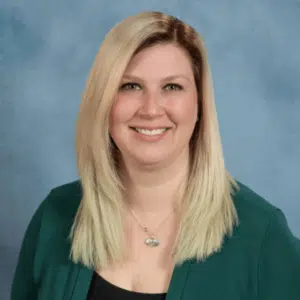 Kristy Walker is a Licensed and Board Certified Behavior Analyst (BCBA) with over 10 years of experience in the field. She received a B.S. in psychology from the University of Iowa and then obtained an M.A. in clinical psychology from Northern Illinois University before returning to her home state of Iowa. Back in Iowa, she worked in a PMIC for children with internalizing and externalizing disorders before becoming a behavior tech in an early skill ABA clinic. Over the last 8 years, Kristy spent the majority of her career working in the Day Treatment Clinic at the University of Iowa Hospitals and Clinics specializing in using applied behavior analysis to decrease severe and challenging behavior. During her time in the clinic, Kristy worked to obtain her BCBA and graduated from FIT in 2018. During her years in the clinic, Kristy utilized cutting edge interventions with children and adults to quickly and efficiently decrease behaviors such as aggression, destruction, self-injury, and elopement. Wanting to expand her repertoire of knowledge and prevent challenging behavior before it begins, Kristy joins the Stride team excited to continue working in early intervention. Kristy currently lives in Cedar Rapids with her husband, daughter, and two feline friends. In her free time, Kristy likes to explore new restaurants and cuisines, spend time with family, and catch up on any horror-related movies or TV.
 Shelley Swan is a Licensed and Board Certified Behavior Analyst (BCBA). She received a B.S.Ed. in Special Education from Northern Illinois University in 2011. After graduating, she worked as a special education teacher for 6 years. During that time, she developed a strong interest in ABA and began working as a behavior technician. In 2017, she completed her M.S.Ed. in Advanced Special Education and Applied Behavior Analysis from Northern Illinois University.

