Now Enrolling Ages 2-6!

Learn more

Is There an Autism Test?

If you think your child might have autism spectrum disorder (ASD), you’re likely wondering about your next steps. You probably have a sense that you should talk to your doctor, but most parents want to know what to expect right away.

Fortunately, there are tools that medical professionals can use to accurately diagnose your child with autism. Let’s take a closer look at the process for identifying ASD in kids.

How Autism Gets Diagnosed

There’s no lab test your doctor can use to determine if your child has autism. Instead, autism diagnoses rely on developmental monitoring. Usually, this starts with both your doctor checking in with your child and you monitoring at home.

To start, your doctor will likely ask you a range of questions about your child and their behaviors. They may also engage with your child and determine if their behaviors and responses seem in line with what’s expected for a child of that age.

To a large extent, though, identifying autism happens at home.

Monitoring at Home

The Centers for Disease Control and Prevention (CDC) recommend that parents screen their children for ASD from birth until the age of five. Specifically, you should be looking at how your child:

  • Acts
  • Learns
  • Moves
  • Plays
  • Speaks

What, exactly, should you be checking? That depends on your child’s age. At-home monitoring for ASD means looking to see if your child is in line with all or most developmental milestones. The CDC has a robust resource you can use to see average milestones based on age.

Here’s a quick overview of many of those milestones:

  • 2 months: Looks at your face, makes sounds beyond crying, responds to you (e.g., smiles when you smile, calms down when picked up)
  • 4 months: Coos and chuckles, turns toward your voice, holds a toy, brings their hand toward their mouth
  • 6 months: Laughs, squeals, seems to know familiar faces, reaches for things, rolls from their tummy to their back
  • 9 months: Has varied facial expressions, lifts arms to ask to be picked up, responds when you say their name, gets into and maintains a sitting position alone
  • 12 months: Waves, looks for hidden objects, starts speaking (e.g., “mama,” “dada”), tried to stand and walk
  • 15 months: Shows affection for you or loved items (e.g., a stuffed animal), has a growing vocabulary, points and gestures, feeds themself with their hands
  • 18 months: Has at least three words besides “mama” and “dada,” mimics you or other children, follows simple directions, walks
  • 2 years: Reacts to your emotions, says two words together, uses a spoon, points to things when you ask (e.g., “where is the cat?”)
  • 30 months: Follows simple instructions, has a vocabulary of around 50 words and uses two or more together regularly, plays pretend, has some dexterity to turn pages, get dressed, etc.

Many kids can get an accurate ASD diagnosis around age two. Monitor their milestones and if something seems amiss, talk to your doctor.

Getting a Formal Evaluation

To get a proper autism diagnosis, you should get a formal evaluation from a knowledgeable ASD professional, like a child psychologist or a developmental pediatrician. Your doctor should be able to connect you to someone who has the necessary    training.

That person may use screening tools like a test your child takes or a questionnaire you fill out as their parent. The diagnostic process gets tailored to your child based on their age and abilities.

This process tells you more than whether or not your child has autism. It can also help you get a clearer idea of their strengths and challenges.

For more help there, consider an applied behavioral analysis (ABA) therapy-based preschool program for your child. At Stride Autism Centers®, we personalize our care for your child to help them reach their unique milestones. To learn more, get in touch today.

What are the Signs of Autism?

That’s a tricky question. Autism — or autism spectrum disorder (ASD) — is an umbrella term that captures a range of developmental challenges. In other words, autism looks different in different people.

All of that said, there are some hallmark characteristics. Knowing the common autism indicators can help parents spot autism in their children as soon as these signs start showing up. That makes a difference because early treatment plays an important role in helping the child overcome any challenges related to their autism diagnosis.

As specialists in autism, our team can help. We developed this guide to serve as a resource you can use to learn about the signs of autism.

The Two Main Signs of Autism

While the way autism appears in people varies widely, most symptoms can be captured in one of two buckets:

  • Trouble communicating with others
  • Repetitive and restricted behaviors

Both of these are behavioral. That means identifying autism may come down to watching how your child interact with the world around them.

To help you get a better handle on what autism can look like, let’s list out some of the most common indicators of this condition.

Symptoms of Autism

As we mentioned before, the developmental differences autism causes result in behavioral changes. All kids are unique, so it may be hard to tell if your child is displaying autism symptoms or is just expressing themselves in a unique way. Are they having trouble communicating or are they fixated on a narrow interestdue to ASD?

To help there, we’ve listed out some of the common indicators that a child is living with autism:

  • Non-response to their own name
  • Repetitive movements (e.g., rocking, hand movements)
  • Trouble making or maintaining eye contact
  • Regular repetition of specific words or phrases
  • Delayed speech or lack of speech altogether
  • Difficulty coping with changes to their routine
  • Picky eating
  • Aversion to touch
  • Light and/or sound sensitivity
  • Trouble following and engaging in a conversation
  • Fixation on a certain interest
  • Organizing toys or other objects in a specific way
  • Hyperactivity
  • Sleep problems
  • Anxiety

As a parent, it can feel alarming to notice that your child doesn’t behave like their peers — or like your expectations. Resist the urge to gloss over what seem like unusual behaviors in your child and assume it’s “just a phase.” Keep monitoring your child carefully.

You should know that autism is both common and treatable. But getting your child the right autism care first requires a diagnosis.

Screening for ASD

If the signs we just outlined sound familiar, talk with your doctor. Getting your child diagnosed requires ongoing monitoring of their development, so starting now matters.

You should probably discuss autism with your child’s doctor if they don’t:

  • Respond to happy faces by six months
  • Make any noise by 12 months
  • Gesture by 14 months
  • Say any words by 16 months

Also, if your child seems to suddenly lose language skills, talk to your doctor. It’s possible for children to develop “normally” to a certain age (e.g., 18 months), then regress. This commonly indicates autism.

If your child gets diagnosed with autism, we’re here. At Stride Autism Centers®, we offer personalized, supportive, applied behavioral analysis (ABA) therapy-based preschool programs. To get started with this wraparound care for your child (and your family), contact our team today.

What is Autism?

If you’ve met one individual with autism, you’ve met one individual with autism. While there are specific diagnostic crtieria for autism spectrum disorder (ASD), the expression of specific symptoms of autism can vary significantly from person to person. In some people diagnosed with autism, we can link the ASD to a genetic condition — but in others, there’s no obvious cause.

It is worth taking the time to understand this complex condition, particularly because it’s so common. In fact, the Centers for Disease Control and Prevention (CDC) estimate that one in 44 children under eight has some form of autism.

With such prevalence, it’s important for the neurotypical people to be well-versed in ASD. In this guide, we give you a quick overview of autism spectrum disorder.

Autism Spectrum Disorder 101

Autism impacts the way a person’s brain develops early in childhood. Autism is now used as an umbrella term that encompasses several previously differentiated conditions, including Asperger’s syndrome, childhood disintegrative disorder, and pervasive developmental disorder.

When a child gets diagnosed with autism, it means that they will deal with certain deficits due to the way their brain is developing. Generally, autism impacts the way that the individual learns, communicates, and behaves.

While an autism diagnosis means the child’s brain develops differently, it may not affect them physically. A child with autism may present as a neurotypical child.

In lieu of physical symptoms, medical professionals have identified two main traits of ASD:

  • Social communication behaviors
  • Restricted, repetitive behaviors

To help us all understand more about this condition, let’s talk about how it impacts the people living with it.

How ASD Affects People

Autism can be hard to wrap your head around because it exhibits differently in different people. While some individuals living with autism are nonverbal, others can have lengthy, nuanced conversations.

Generally, though, ASD creates challenges for the diagnosed individual in the following areas:

  • Communication, both verbal and non-verbal (e.g., gestures)
  • Social interaction
  • Eating and sleeping habits
  • Symptoms of attention-deficit/hyperactivity disorder (ADHD)
  • Limited interests
  • Repetitive behaviors

Ultimately, autism is a complex developmental disorder that can create a range of challenges for the individual. Fortunately, those obstacles don’t have to be insurmountable.

Spotting Autism Early

Extensive research shows that early treatment for people with ASD makes a big difference in helping them realize positive life outcomes. As a result, it’s important for parents to monitor their child’s development. In most kids, the signs of ASD develop by age 3. In some cases, you may start noticing differences as early as 12 months.

Once a child gets diagnosed with autism, their family has the opportunity to create a support system around them. The diagnosis often feels overwhelming. Remember, though, that you now have clarity about the situation at hand. Armed with your child’s diagnosis, you can start taking steps to give them the right care at home and connect them to treatment to help them. Many people with autism go on to lead healthy, happy, productive lives.

You don’t have to navigate this road alone, either. Our team of autism specialists here at Stride Autism Centers® can help. We offer tailored programs for preschoolers with autism designed to help them thrive. If you think your child might be living with autism, let’s talk.

LEGOs: A Powerful Building Block In Your Toolbox

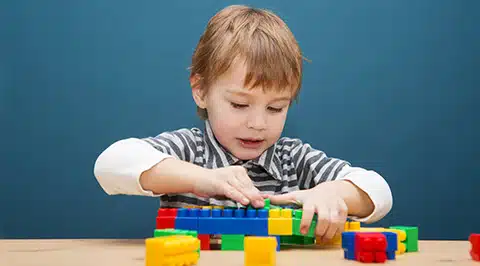
What most people see as a toy can be a lot more than that. In fact, if you’re the parent of a child with autism, LEGO blocks could be one of the more useful assets in your toolbox. That’s because these blocks give you a way to have fun with your child while also encouraging their development.

The draw of LEGOs

Kids with autism generally like structure and rules. LEGOs provide that. They fit together a certain way. They’re predictable. While the possibilities of what you can build are endless, the foundation for that building is easy to grasp.

Here, we’re talking about the traditional LEGOs you probably picture when you think about this toy: the square or rectangular blocks that can stack on top of one another. The LEGO brand has come a long way since the blocks of yore and they now make some pretty complicated sets and kits. If you discover that your child with autism really likes LEGOs, you can work your way up to the sets with more unusual pieces. To start, though, traditional LEGO blocks are generally best.

Using LEGOs at home

Having a basic LEGO set at home can provide you and your child with a wealth of opportunities for enjoyable, developmental time together.

To help you get started, here are a few options.

  • Sort the LEGOs. Dump all of the LEGOs out on the floor. With your child, decide how you’re going to sort them. Sorting by color can be an easy place to start, but you could also sort by size or the number of studs on top. Then, sit together and sort all of the blocks into the appropriate piles. You may want to create an index card to put in front of each pile to label it, making it clear what should go in the pile. If your child can’t yet read, use visual cues (e.g., color the card or draw the number of studs).
  • Follow instructions. Set up a simple outline for your child. This could be something like: “Build something using three blue blocks, four red blocks, and two green blocks.” As they learn the ropes, you can make things more complex, potentially giving instructions on color, size, and number of studs.
  • Sibling play. Each of the above games could include your other children, as could a free-play LEGO session. Since LEGOs are easy to use but can be scaled up based on the child’s interest and ability, each of your children can do what’s right for them while still playing together.
  • Build while you talk. Some kids with autism find it more comfortable to hold a conversation while doing another activity. This prevents them from needing to make eye contact, which can feel uncomfortable, and can “fill” gaps in a conversation as they process. Once your child gets used to playing with LEGOs, consider using this play time as an opportunity to foster conversation between the two of you.

If you’ve been looking for a tool to support development at home, LEGOs can deliver. Start simple so your child doesn’t get overwhelmed. If they like the LEGOs, you can add more complexity — both in the things you do with the blocks and in the LEGO sets you buy.

LEGO play at home can complement the combined learning-playing we do here at Stride Autism Centers®. To learn more about our ABA therapy-based program for children with autism, get in touch.

Navigating Air Travel With Children With Autism

Children with autism like structure and predictability — two things that often fall by the wayside when you’re flying. With everything from travel delays to noisy airplane engines to contend with, you probably have a fair measure of concern if you have upcoming air travel plans with your child.

Fortunately, you don’t have to invent the wheel here. Families have been traveling with their children with autism for decades. They know where the challenges lie and what can help. What’s more, many airports and travel authorities like the Transportation Security Administration (TSA) have taken steps to make air travel easier for people with autism.

To help you navigate your upcoming travel day, we’ve gathered up some of the best practices you can put to work for your family. Here are four things that can help to make air travel easier for your child and all of their travel companions.

Start Small

Air travel brings in a significant amount of new stimuli and it’s highly likely that your child will get overwhelmed. To make this easier on them, it can be helpful to start with a short, direct flight.

If you know you need to go somewhere far in the future (say, for example, you’re visiting family across the country later in the year), consider booking a short getaway soon. This way, your child can get exposure to all of the newness of air travel in a way that might feel more manageable.

Help Them Know What to Expect

The unknown triggers fear in all of us, but it’s particularly heavy for kids with autism. Taking some steps to prepare them at home can go a long way. A few weeks before your flight, start talking to them about air travel. You might read books about airplanes or watch videos from airports. YouTube often has livestream videos running from airport terminals around the world.

If you live near an airport, you might even visit it before your travel date so your child can see what it looks like.

Getting some familiarity with airport/airplane environments can help your child feel much more comfortable on the day of your flight.

Explore Your Support Options

Many airports and airlines offer support for families with children on the autism spectrum. Some airports will let you take a tour of the airport so your child can learn more about what to expect before the day of your flight.

You can also contact TSA Cares and request support through the screening process.

On top of all of that, the Philadelphia International Airport has developed some Social Stories that can help you and your child prepare for the travel day.

There may be more resources at your departure and arrival destinations. Do some research to see what’s available to your family.

Bring Tools to Help

Earplugs or earmuffs can do a lot to help your child manage the high noise levels that come with air travel. Consider packing their favorite snacks and a couple of their favorite toys, too. Having things they enjoy with them can provide a welcome distraction if they get overwhelmed at the airport or on the plane.

Your child is more likely to have an enjoyable, calm travel day when they’re already working on social and coping skills. We can help. At Stride Autism Centers®, we apply ABA therapy to help kids with autism thrive. To learn more, get in touch.

Looking For An Activity To Do Together? Get Crafty

Crafting can help your child with autism develop fine motor skills while simultaneously encouraging their self-expression and building self-confidence. In short, it’s a great way to support their growth toward their happiest, healthiest self. Plus, it can be fun for them and you.

For kids with autism, sensory crafts can be particularly enjoyable. You want to find craft projects that engage their senses. That includes sight, of course, but you might also want something they can feel (like Play-Doh) or smell (like scented markers). They may also really enjoy crafting with natural materials, like good-smelling flowers or highly textured pinecones.

Craft time is a chance to find out more about what your child likes while also encouraging their development. Since kids with autism thrive when they have structure, it can be helpful to set up a specific craft project for them. To get you started, here are a few ideas:

Finger Painting

You can make your own non-toxic finger paint with ingredients you probably already have on hand. And making the paint can be fun for your child with autism since it gives them the chance to mix their own colors.

Add some flour to a bowl, then add enough water to get a thick liquid — remember, you want to be able to paint with your fingers here. Then, grab some food coloring. Mix up a few different colors so your child has options.

Next, get a blank piece of paper or canvas. Your child may want to craft freely, but some kids benefit from more direction. You might encourage them to paint your family, a nature scene, or something you know they love (like dinosaurs or trains).

If your child with autism doesn’t like getting dirty, they can still get the sensory benefit of finger paint. Just put a pair of latex gloves on them before they get started.

Play-Doh Sculptures

Just like with finger painting, some kids with autism will dive straight into crafting but others will need some guidance. Think of things that would be relatively easy to mold out of Play-Doh, like your house or a truck. If your child enjoys sculpting simple items, you can encourage them to make more complex ones, like a sculpture of their sibling.

Engaging with the Play-Doh engages multiple senses at once while giving them a way to express their creativity in 3D form.

Art From Nature

Start with a walk around your neighborhood to gather supplies. This could be rocks, leaves, flowers, pinecones or needles, dirt, a found feather, or anything else you come across that catches your child’s eye.

Head home with your haul and give them some child-safe glue and a blank piece of paper. Let them arrange their found treasures into a piece of art, attaching them to the paper with glue. Not only does this give your child a chance for self-expression, but it can also help them look for beautiful objects when they’re out in the world. They may even start a collection to use in future art projects.

Crafting gives kids with autism the opportunity to learn skills while fostering their own creativity. That’s why we make it part of our days here at Stride Autism Centers®. If you’d like to learn more about our program for young kids with autism, contact us.

What to Consider When Searching for a Preschool for Children With Autism

When looking for a preschool for your child with autism, you have a lot to consider. You want a place they’ll feel safe and comfortable. You want the teachers and staff to be excited about their work and ready to partner with you. And you want to make sure that your child is in a program that helps them become independent, joyous, and successful in elementary school and beyond.

While all preschools try to help children learn to socialize and communicate with their peers, kids with autism usually need extra help in these areas.

How do you select the best preschool program? Here are a handful of questions you should ask when you’re looking at preschool options.

Is the treatment evidence-based?

When someone is diagnosed with autism, getting them treatment as fast as possible makes a huge difference. In fact, early intervention for preschool-aged children can transform their life.

You want to be sure that your preschool is applying evidence-backed treatment. Most medical experts, including the U.S. Surgeon General, agree that applied behavior analysis (ABA) therapy best fits kids with autism.

To ensure your child gets the right treatment for their specific needs and goals, PhDs developed our ABA-based program here at Stride. They also provide ongoing oversight. Additionally, we maintain relationships with several leading academic institutions that help support our programs and ensure we are integrating the latest research.

How is the staff trained and supported?

Every relationship matters for your child. When you’re comparing preschools, look for one that provides dedicated training to all of its staff. Here at Stride, for example, we give all of our employees extensive in-person training with our clinical leadership before they start working with your child. Then, we provide ongoing supervision to ensure they are continuously progressing and implementing the highest quality care.

It’s also important to choose a preschool that supports its staff. We believe that when our team members are well taken care of, they’re better positioned to take the best care of your child. That’s why we set our team up with mentors who are senior clinicians in the field of ABA.

Does the preschool collaborate with you?

Children with autism benefit from a seamless day. They can get understandably confused if they have one experience at home, then a completely different one at preschool.

The best preschool for your child will be one that works hand-in-hand with you. They should not just support your child while they’re at the center, but also help you learn tools and techniques you can use to help them at home.

At Stride, we see our relationship with our preschoolers’ parents as a collaborative one. We’re a team working together to support the best outcomes for your child.

In fact, we’re family-owned, so we truly understand the importance of the family/preschool partnership. Our founder’s sister has a severe autism-related disorder, and everything we do is born out of the desire to help families in similar situations.

If you live in Illinois, Iowa, or Nebraska and are currently looking for a preschool for your child with autism, we would love to see if Stride Autism Centers® is right for your family. To explore this option, contact us.

How Important is the Right Environment for Children on the Spectrum?

As soon as your child got their diagnosis — and potentially even before — you probably started modifying their environment. You made safety changes at home (like child-safety locks) and sensory adjustments, as well (like removing something overstimulating from their room).

But don’t stop there. For a child with autism, the right environment makes all the difference.

Children with autism, like all children, crave safety and consistency. An environment that feels comfortable and predictable sets them up for success.

Why environment matters

Think about a time when you’ve been overstressed, overtired, or otherwise overstimulated. That’s not how you want to head into an important event, right? Because their surroundings and the events of the day can be so much more stimulating to a child with autism than to a neurotypical person, it’s easy for them to get into that overstimulated state.

That does them no favors. In the same way that you’re not at your best when you’re overworked or overstressed, your child will struggle more if their environment requires too much of them.

Conversely, a secure environment in which activities are known and can be anticipated can bring them a huge measure of calm and security. From that place, they’re better able to respond to what happens around them.

The trick here is that you need to balance the predictability your child craves some level of stimulation. Without the latter, your child won’t grow or learn new skills. You want to help them have a sense of control while also encouraging their development.

Creating the right environment

Here at Stride Autism Centers®, we have extensive experience creating the right environment for kids with autism. We wanted to share some things that have worked well for us.

For starters, build a space that feels calm and safe. That means childproofing your home, of course, but it also might mean removing audio and visual stimulants. Keep your space at a comfortable temperature and consider eliminating things like lights that flicker or fans that hum.

A safe, calm environment gives you a good blank canvas from which to build. Next, focus on creating structure. Rules and expectations should be clearly laid out (you might want to create a visual guide). Routines should be established, communicated, and posted in a way your child can see. A schedule or a list of pictures (if they can’t read yet) can help them anticipate what’s coming. Having a set routine gives them a sense of control because they know what to expect and can ready themselves for it.

Finally, from that place of safety and calm where rules and routines are established, you can look for ways to provide the right level of stimulation. That could be a once-weekly trip to the grocery store or a specific type of playtime on special days. From the established routine, you can build to give your child opportunities to develop skills and explore their world.

To give you an idea of what’s been successful for children with autism, we’ll share that we have four specific environments we provide at Stride:

  • Individualized instruction space where the child engages one-on-one with their therapist in a room with few distractions
  • A free play/natural environment space where kids can engage in play-based activities like art, blocks, and toys
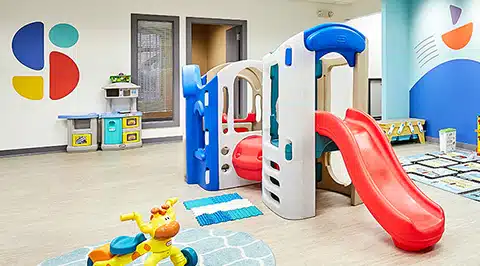
  • Playgrounds where they play and climb on sensory stimulating environmental elements like slides, swings, mini trampolines, and tunnels
  • Circle time areas where we gather in a seated circle with other children to go over the day’s routine

Each environment is tailored to keep them safe and provide a sense of calm while encouraging learning and play. As you tailor your in-home environment to your child with autism, we can come alongside you to provide the right environment for their therapy and group skill development.

To learn more, contact us.

How Does Autism Affect Social Development & Social Skills?

One of the core deficits with autism is social skills. Individuals generally possess a desire to interact with those around them — but often do not know how to begin. This can lead to confusion, frustration, and other emotions.

Fortunately, this presents an opportunity. By understanding how autism affects social development and social skills, the individual and their support community can work to fill in gaps. As they build awareness and aptitude around socializing, the person with autism gains confidence. This can help to foster better social engagement, putting them on the path to building stronger social skills.

Autism and socialization

None of us are born fully understanding how to interact with the people around us. That’s something we learn over time. We are taught how to take turns and we pick up the natural flow of conversation through the years. The difference is that this might come more quickly and easily for a neurotypical person than for someone with autism.

That’s because autism can affect:

  • Verbal skills and expressing oneself effectively
  • Communicating one’s wants and needs
  • Rapport building with others
  • Perspective taking (i.e., putting yourself in someone else’s shoes)
  • The ability to pick up on social cues
  • Sensory perception (e.g., awareness of body language)
  • Ability to understand situational context

While a neurotypical person might not think much about some of these things, they all play large roles in social situations. They help you anticipate what’s to come and react “appropriately.” Consequently, someone with autism might feel as though they’re flying blind in social settings.

Developing skills

Fortunately, both at home and in a dedicated learning space like Stride Autism Centers®, children with autism have the opportunity to develop the social skills they may have had trouble building before. As the adage goes, practice makes perfect.

At home, start by building on their strengths in a way that’s comfortable for them. Engage in conversation — encouraging a back-and-forth and listening — about a topic you know interests them. Play a game you know they enjoy, but emphasize turn-taking. By fostering social skills in a platform that’s comfortable for your child, you can help them build these abilities without feeling overwhelmed.

Also, look for teachable moments. Generally, it can be helpful for someone with autism to have abstract concepts broken down into concrete components. “Body language” can be hard to grasp. Instead, say something clear like, “When you play with something else and look away when I’m talking, I feel like you’re not listening to me.”

The goal here is to build your child’s self-esteem along with their self-awareness. So start small and work your way up, providing encouragement and clear direction along the way.

We’re here to help. We emphasize effective play and social skills at our centers. At Stride, we give children opportunities to interact with their peers in a structured, supportive environment. With our naturalistic group activities, we support their development and foster school readiness.

If you want to learn more about how we can help your child build the social skills they need, get in touch.

Stride is Proud to Sponsor Upcoming Fundraisers in Communities it Serves

At Stride, we firmly believe that every child deserves a rewarding future full of happiness and independence. That is why, in addition to offering full-day ABA programs for children ages 2 to 6 across Iowa, Nebraska, and Illinois, we support autism-related organizations that are aligned with our mission.

This September, we are pleased to be sponsoring two incredible fundraising events to support those with autism and their families. First, we are a Platinum Sponsor for Chicago Autism Network’s 5th annual Fall Gala. Taking place on Saturday, September 10th, this special evening is meant to raise money to help those who could greatly benefit from autism therapy but are currently unable to afford it.

We are also a Gold Sponsor of the Autism Society of Iowa’s Annual Fore Autism Golf Outing taking place a few days later on September 14th. Proceeds from this wonderful event will help support the organization’s efforts to assist individuals with autism across the state.

Stride looks forward to sponsoring additional events in the future as we continue our mission to enrich the lives of children with autism spectrum disorders.

Call Now Button